

Losing Power – Finding Joy
A Reflection on Ecclesiastes 8

(My explorations into Ecclesiastes 8 first existed as an academic paper, which you can read here, if you’re interested in jaunting into Phil’s nerdy forest)
One of the most formative “seasons” in my life was the six years my family belonged to dhiiyaan — a small, Aboriginal Christian community that began in Brisbane.1 At the time we came along, there were about ten families who met in homes and borrowed places across North Brisbane. Unlike any “church” gathering from my past, our time was spent around full tables, with lots of kids running around and flashes of insight from Billy (Jangala) Williams, whose teaching wove together scripture and story, prophecy and poetry.
A few months before we arrived, another not-for-profit organisation “gifted” dhiiyaan (pronounced dee-yawhn) with a 40-acre property just over 3 hours into the country and away from Brisbane. Saying it was a “gift” is charitable. The property was terribly run-down. The houses were falling apart, the land was overrun with cacti, and there were no notable signs of vibrant, healthy life. Billy, however, sensed that this property was connected to their next “season” and where God was drawing the community, who were in the early stages of processing profound grief due to a horrific trauma experienced in the community. There was a real sense that, as we worked together to heal and restore the land, we too would find healing.2
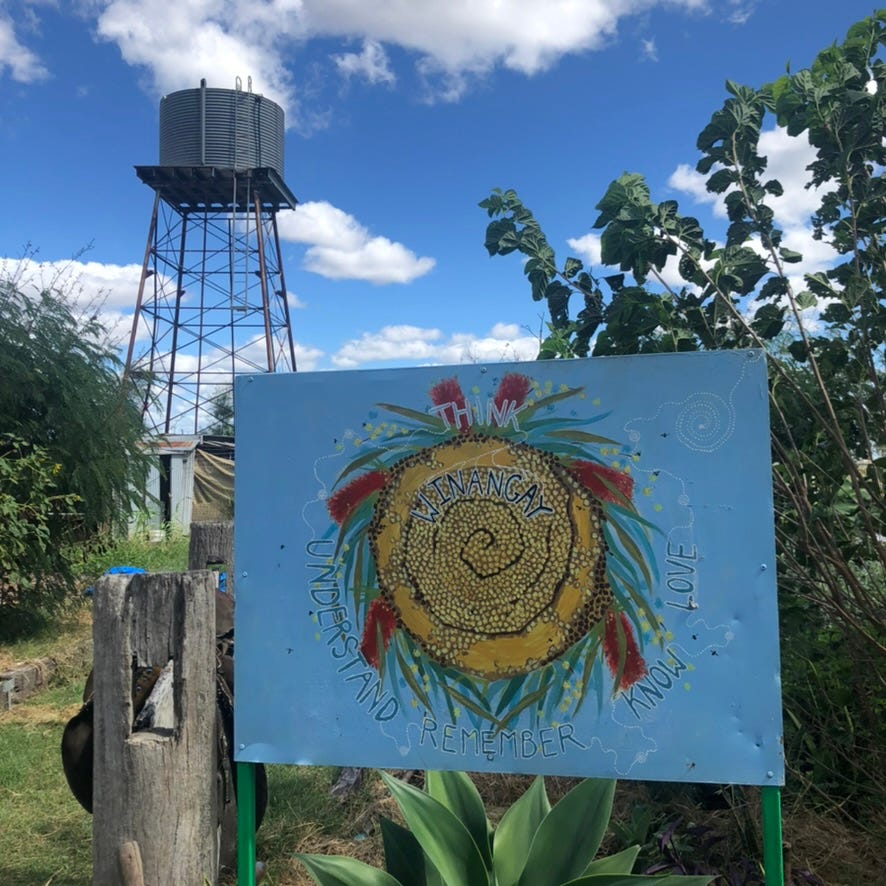
For years, every second or third weekend, many families would make the three-hour trek out to Bethel – the name given to the 40-acre property. Slowly, the community began the work of restoration. Gardens were planted, animals brought in, houses were renovated — one wall, one bathroom, one floor at a time. What was once neglected began to breathe again with new life.
Billy and Vicky, the “leaders” of dhiiyaan (the Gamillaraay word for ‘family’), were not the kind of leaders I was used to. They didn’t present themselves as people with answers neatly organised and systemised on shelves, ready to hand out to everyone who had a question or a doubt. Nor did they exercise authority as a top-down structure. Instead of giving certainty, they invited us into complexity.
During breaks for morning and afternoon tea, Billy, a Gamillaraay man, taught us phrases from the Gamillaraay and Warlpiri language groups alongside our wrestling with the Christian Scriptures. We read the traditions together, and Billy did so without flattening either tradition into something simplistic.
Real questions of life, culture, diversity, unity, and faith can’t be reduced to memes or truncated into tidy explanations. Our life together made this evident.


This beautiful and complex community learned to both laugh and weep together. Billy and Vick showed us that whatever is meant by “leadership” is found at the bottom, in the dirt and sweat and cuts and tears — of our own stories and in the stories of our neighbours. Our wounds were our entry point — the place where we could be seen and known and loved. This too had its complexities. The truth is, not everyone is safe with woundedness or able to hold these tensions — and yet we had to find a way for those people to belong too. Like I said, life isn’t simple, and authentic community shouldn’t be romanticised.
The land also taught us this wisdom. As we dug into the soil and began to plant gardens, we saw that if you want control, you plant a monoculture. A single crop is easier to manage. It behaves predictably. You can organise your systems around it.
But healthy soil rarely works that way.
Healthy soil is alive with diversity — plants, organisms, roots, fungi, insects — a layered complexity that can’t be diluted without compromising its health. The more alive the soil becomes, the less tidy and manageable it appears.
The culture I was raised in prized efficiency and clarity, but this was a way of being that resonated deep within me. Too much of my own church experience existed as a monoculture. Sure, they may feel safer. Simpler. Easier to manage. And it seemed we preferred leadership that looked strong and certain, giving explanations that made the world — and God — predictable. To say it another way, it tried to keep God in our service.
During many of our family’s weekend treks out to Bethel Farm, as it came to be known, I was also deep into my undergraduate work in Biblical Studies. Much of that season was spent immersed in Israel’s so-called “Wisdom Literature”—the books of Proverbs, Ecclesiastes, Songs of Songs, and Job.3
I remember feeling surprised at how often what I was discovering in Ecclesiastes, a largely unexplored book for me at that point, was being mirrored in my experience with our community and in the soil which we were learning from at Bethel. Week by week, I was reading this strangely wonderful book from the Hebrew Scriptures—a text that refuses easy answers, questions the reliability of power, and stubbornly resists the tidy cause-and-effect theology I’d heard espoused most of my life. In fact, scholar Ellen Davis, among others, makes a point of mentioning just how strange, enigmatic, eccentric, and contradictory this book is in comparison to much of the Hebrew Scriptures.4
The voice of the “Teacher” (Hebrew: Qohelet) in Ecclesiastes writes as someone who watched the world closely and noticed cracks in the more simplified wisdom of Proverbs. Too often, he saw those who do right and live justly suffer at the hands of evildoers. He’s seen years of hard work accomplished by a father squandered by the foolishness of a son. He knows life isn’t as straightforward as some say. He knows the experiences of this world are often troubling, uncertain, and paradoxical — like a vapour in the wind, as soon as you reach out to grab it, it slips through your fingers and is gone.
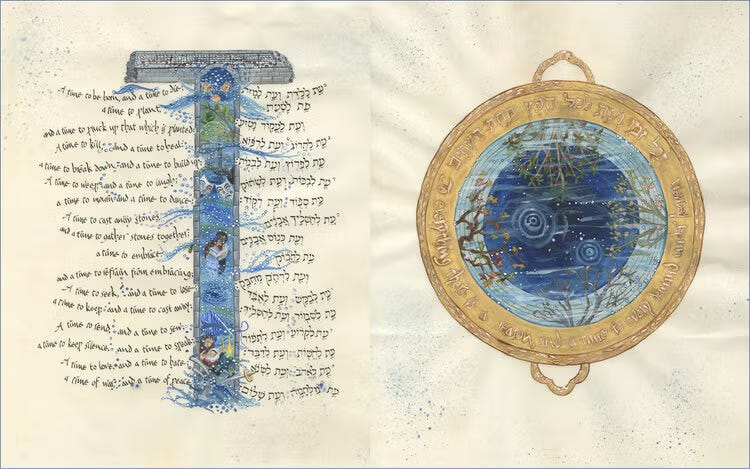
Hevel is what the Teacher calls our enigmatic existence. Hevel is translated as “vanity”, “vapour”, “futility”, “mist”, or most often, “meaningless”. But Jewish scholar Michael V. Fox has one of my favourite renderings, translating hevel as “utterly senseless”.5
It’s no surprise that hevel is also the name given to Adam and Eve’s second-born son — Abel. Abel’s life exemplifies this strange thinness. Truly, his short story stands as one of the most utterly senseless narratives in the Bible, sparking thousands of years of unanswerable questions, speculation, and debate. After all, wasn’t Abel the favoured one by God? But how long did that last? Wasn’t it his blood that was spilt by his brother, Cain? The first narrative we encounter east of Eden reminds us that justice will not always unfold as neatly as we would like and challenges us to rethink the thinness of a theology of causality.
.
At some stage during my studies, I found myself working slowly through Ecclesiastes 8. This is where Qohelet turns his attention to kings, authority, and the systems of power that structure the world. On the surface, it reads like fairly standard advice: obey the king (8:2), don’t be rash in his presence (8:3), respect the authority of those in power (8:4–5).
But like much of Ecclesiastes, what sounds straightforward at first begins to unravel the closer you pay attention.
The chapter opens with a short poem:
“Who is like the wise?
Who knows the interpretation of a thing?
A person’s wisdom makes their face shine,
and the hardness of their face is changed.” (Eccl 8:1)
That phrase—“face shine”—isn’t random language. It echoes a much older story in Israel’s imagination. When Moses comes down from Mount Sinai after being in the presence of God, his face shines (Exodus 34:29–35). It’s not just about emotion or mood—it’s about a kind of radiance that comes from encountering reality as it truly is, from being aligned with something beyond yourself.
But Qohelet, in Hebrew poetic form, pairs that image with something unexpected.
He says that wisdom doesn’t just make the face shine—it changes the hardness of the face. The word “hardness” carries the sense of something set, rigid, even defiant. It’s the kind of face you learn to wear in a world where control matters. A face that doesn’t give much away. A face that holds tight to power and authority. And yet, according to Qohelet, wisdom does something to that hardness. It softens and, in Hebrew, shanahs it (literally this means “to become dull”).
As the chapter goes on, Qohelet doesn’t paint a reassuring picture of how the world’s power works. He acknowledges the reality of authority: “the king’s word has power” (8:4). There is a structure to the world, he claims, and it’s not wise to pretend otherwise. But almost immediately, the tone shifts. The wise person may discern “a proper time and procedure” (8:5–6), yet they still don’t know what will happen next. No one can fully control the future. No one can hold onto their life indefinitely (8:8).
And then comes the deeper tension.
Qohelet observes that the system doesn’t work the way we expect it to. The wicked sometimes receive the honour we would assume belongs to the righteous (8:10). Justice is delayed. Because of that delay, “the hearts of people are filled with schemes to do wrong” (8:11). Even when he affirms that it will ultimately go better for those who fear God (8:12–13), he immediately complicates it again: “there is something else meaningless—hevel—that occurs on earth: the righteous who get what the wicked deserve, and the wicked who get what the righteous deserve” (8:14).
This is not neat. It’s not predictable. It resists any simple cause-and-effect explanation of how the world works. And right there—in the middle of that tension—Qohelet places this image:
Wisdom makes the face shine,
and strength, as we’ve known it, is undone.
In other words, wisdom is not the ability to master the system, but the capacity to live within its limits without becoming hardened by it. It’s the kind of knowing that doesn’t produce tighter control, but creates a different posture altogether—one that is open, responsive, and vulnerable.
And then, almost unexpectedly, Qohelet makes a turn, but a turn that leans into the tension.
He says in response, “So I commend joy…” (8:15)
Not because everything makes sense. Not because justice has been restored. Not because the system has been fixed. But because, in a world where power cannot secure the outcomes we long for, something else becomes possible.
Joy.
Qohelet describes it simply: to eat, to drink, and to find enjoyment in one’s work—these ordinary, grounded gifts that accompany us “under the sun”. A joy that is freely given and freely received, rather than won by conquest. A joy that does not depend on life being predictable, fair, or resolved to see and say that God is good.
Which, for me, began to feel less like an ancient, abstract idea and more like something I was actively witnessing.
At Bethel, power, authority, and leadership didn’t look like a “hard” face. It didn’t look like power, certainty or control, or having everything resolved. Billy carried the authority of a true Elder, but it was far from the kinds of authority I had been taught to recognise. He carried no need to dominate outcomes or rush to answers. He was willing to let things be complex—willing to serve and love people as they took the time they needed, and willing to let the land recover slowly, unevenly, wisely.
Billy showed strength, but not because he was holding everything together. It came from letting himself and those around him be what they were—weak, broken, and vulnerable—and staying present to it all. And almost without fail—despite the grief, the hard work, the traumas we all carried—something else emerged alongside that kind of powerlessness.
Joy.
It wasn’t showy or performative, or dependent on everything going well. But in our presence to each other, in big meals shared after long days of work, in laughter that came easily—even in the middle of uncertainty and often on the back of weeping—and in the deep satisfaction of watching life, plants, animals, and people return to the land.
As I said at the top of this piece, my time with dhiiyaan and out at Bethel remains one of the most spiritually formative times in my life. The parts of me—which I came by honestly—that learned to rely on external façades, quick answers, clear systems, predictable outcomes… began to loosen and fall away.
I believe Qohelet. I trust that genuine wisdom isn’t looking to give us more power or control. It releases us from them—to make us more open, more vulnerable. More able to live in a world where justice doesn’t always arrive on time, where outcomes can’t be guaranteed, where life doesn’t follow a clean script.
And somehow, it is there—in that loosening—that joy finds you. Not as something we gain by climbing and clinging, but as something we are finally free to receive.
Maybe that’s what it means for wisdom to truly make our faces to shine.
Postscript:
This post is running way too long already, but as I worked to wrap this article up today, I was also listening to a recent episode of Conan O’Brien Needs a Friend. He was interviewing comedy writer and directing legend, James Brooks. Conan asked Brooks what it was like working on these iconic TV shows that many of us watched growing up. Specifically, as Brooks recounted his time working on the Mary Tyler Moore show (look it up, kids), he made a comment about MTM that resonated so deeply with this article. He said on the set of her show, Mary had all the power, but that “she used all the power she had not to have the power”, and in doing so fostered a profoundly joyful experience which was shared with everyone on set.6
My awesome sister-in-law, April, tells me using “seasons” as a metaphor for a particular chunk of time in life is a distinctly Christian thing… This surprised me. What say you? Also, we still very much belong to this community, but just in a way that is different due to proximity.
As with the Hebrew Scriptures, much indigenous wisdom sees an unbreakable connection between humanity (Heb. adam) and the ground (Heb. adamah). On the Hebrew side, have a look at Norman C. Habel, The Land Is Mine: Six Biblical Land Ideologies (Minneapolis: Fortress Press, 1995); Ellen F. Davis, Scripture, Culture, and Agriculture: An Agrarian Reading of the Bible (New York: Cambridge University Press, 2009); and on the Aboriginal side, see the stories of many language groups—compiled by Jim Sinatra and Phin Murphy, Listen to the People, Listen to the Land (Carlton, VIC: Melbourne University Press, 1999)
The term ‘Wisdom Literature’ in biblical scholarship typically refers to Proverbs, Ecclesiastes, Job, and, some would argue, Song of Songs. However, there is good reason to resist the view that these books exist as an island unto themselves, disconnected from the Hebrew narratives. I, among others, argue that these texts, when read closely and intertextually, are deeply embedded in Israel’s story and thus should be thought of as an integrated part of the whole. From this perspective, not only these books but also the whole of Israel’s Scriptures should be thought of as ‘Wisdom Literature’.
For instance, see Ellen F. Davis, Proverbs, Ecclesiastes, and the Song of Songs (Louisville, Ky: Westminster John Knox Press, 2000), 159.; Michael V. Fox, “Ecclesiastes,” The JPS Bible Commentary, (Philadelphia: Jewish Publication Society, 2004), ix; Roland E. Murphy, Ecclesiastes, Word Biblical Commentary, (Grand Rapids: Zondervan, 1992), xvii.
Michael V. Fox, Ecclesiastes, WBC, 3.