


In this short study, I explore whether Christian spiritual guidance can remain genuinely ‘Christian’ when AI-mediated companionship begins replacing the embodied, communal, and relational practices through which discipleship to Christ has traditionally been formed.
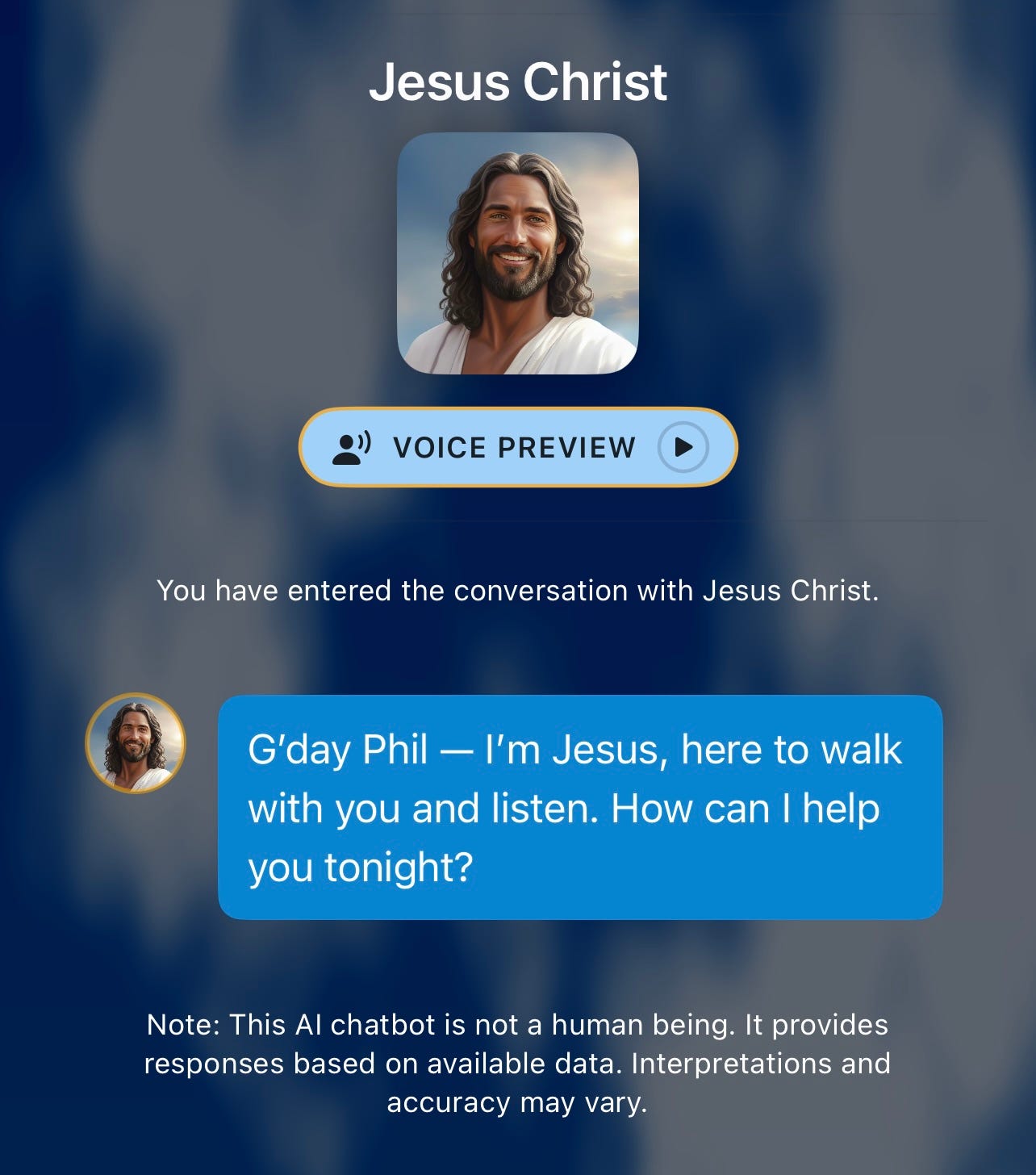
Let’s consider a man who, in the past few years, began to grow tired of ‘church’ as he knew it. In his disenchantment of what felt like narrow-minded teaching, disappointing leaders, and disingenuous people, he slowly drifted away from the gathered people of God. While ‘attending church’ no longer appeals to him, he cares about his spiritual life and so has begun engaging in ‘spiritual’ discussions with an AI chatbot. Doing so, he claims to be experiencing, in his terms, rapid growth.
He is learning new theological concepts and feels ‘heard’ in a way he hasn’t previously – and without the thorniness of failed leaders and frustrating fundamentalists. Best of all, he doesn’t have to wait to book an appointment with a pastor or, for that matter, even get out of bed. It felt strange at first, but he has even begun asking his chatbot to pray for him. He always leaves his ‘sessions’ encouraged and feels he knows more than ever. Over time, the chatbot has become what he calls his “church”. His AI chatbot is now his primary theology professor, spiritual director, and pastor. He may not be a part of a traditional church, but “He and Jesus”, the man says, “are doing great.”
To many, this scenario may sound absurd, but in truth, more and more people are turning to AI for serious conversations about real needs in life – including spiritual life.1 But should this man’s experience be dismissed outright? Researcher and theologian Ron Cole-Turner argues that AI can genuinely assist in reflection, theological exploration, and emotional articulation.2 Drawing on the research of psychiatrists Kay T. Pham, Amir Nabizadeh, and Salih Selek, he states that there are increasing numbers of people who feel they can be more vulnerable with a chatbot, knowing that they can be totally honest without fear of judgment.3
The reality of this shifting search for soul care offers an invitation to the Church to examine why many people increasingly experience technological spaces as safer and more attentive than Christian communities. The attraction of AI is not merely access to information but the experience of feeling ‘heard’.
In an age marked by loneliness, spiritual uncertainty, and distrust of institutions, not to mention the shift of focus of many churches away from a shared life together toward the ‘Sunday Experience’, the promise of immediate accessibility and thoughtful companionship can be understandably compelling. But with its perceived benefits, might there also be a shadow lurking inside of this trend?
Throughout Scripture, its authors consistently present our life with God as something that occurs within relationships of mutual participation. From Genesis, where it is declared that it is not good for the human to be alone (Gen. 2:18), to Israel’s identification as YHWH’s covenant people (Exod. 19-24), to Jesus gathering disciples around a shared life rather than merely distributing teachings (Mark 3:13-19), the thread running through much of the biblical story assumes that faithful life with God occurs in and through the shared life of community.
Paul’s letters repeatedly call believers to bear one another’s burdens (Gal. 6:2), forgive one another (Col. 3:13), submit to one another (Eph. 5:21), encourage one another (1 Thess. 5:11), and outdo one another in showing honour (Rom. 12:10), and that Christian maturity is revealed not simply by what one knows but by how one loves (1 Cor. 13:1–13). As McQuilkin and Copan observe, the work of the Spirit operates in participation with “human instruments to help us become more virtuous, Christlike persons.”4 Christian formation, it seems, is not merely informational but relational, embodied, and communal. But even with these considerations, could an AI chatbot, as Cole-Turner argues, be “a means of grace leading to authentic spiritual growth”?5
In his review of John Barclay’s monumental work, Paul and the Gift,6 Scot McKnight highlights Barclay’s argument that Paul’s theology of grace is fundamentally communal.7 God’s grace in Christ does not merely save isolated individuals; it creates new communities whose relationships are reshaped by the Christ-gift. The Apostle Paul speaks of the church as one body with many members – all of whom belong to one another in love, service, and mutual submission (Rom. 12:4–5; 1 Cor. 12:12–27; Eph 4:1-6, 11-13, 15-16; 5:21). Drawing on ancient understandings of gift-giving, Barclay argues that gifts are not simply transactions, but means of creating and sustaining relationships.
McKnight summarises Barclay’s position stating that gifts express “a social bond, a mutual recognition of the value of the person. It invites a personal, enduring, and reciprocal relationship.”8 Grace, then, according to Barclay, is not merely something received from God; it becomes something offered to others through forgiveness, hospitality, service, sacrifice, and love. Barclay concludes that for Paul, those who have experienced God’s grace are expected to respond in love and grace.
The Christian life is therefore shaped by reciprocity – not in the sense of earning God’s favour, but in participating in the communal life that God’s grace/gift creates. If we accept Braclay’s understanding of grace, which I am inclined to do, can we also accept the suggestion of Cole-Turner? But if grace is fundamentally reciprocal and found in embodied participation, can AI be seen as Cole-Turner’s “means of grace”?
A chatbot may very well provide thoughtful responses, encouragement, theological insight. It may help a person articulate questions, reflect on experiences, or explore complex conceptual ideas. However, it cannot genuinely participate in the reciprocal exchange of grace that lies at the heart of Christian community. It cannot forgive or be forgiven. It cannot bear another’s burden while asking others to bear its own. It cannot receive sacrifice, offer hospitality, submit itself in love, or be transformed through relationships. The question is then not whether AI can discuss grace, but whether it can participate in the kinds of relationships through which grace is embodied and experienced.9
Pope Leo XIV, in his recent Encyclical Letter, reflected on AI and its potential impact (both positive and negative) on our humanity. He writes, “the artificial imitation of positive human communication — words of advice, empathy, friendship and even love — can be engaging and at times genuinely helpful,” but also warns that it may also create the “illusion of a relationship…the danger is not so much that a person may believe they are communicating with another person, but rather that they may gradually lose the very desire to form genuine human connections.”10 The Pope also distinguishes AI intelligence from that of humans. AI models, he claims, “do not understand what they produce, for they lack the affective, relational and spiritual perspective through which human beings grow in wisdom.”11
Nearly a century ago, Bonhoeffer wisely and prophetically cautioned against leaning away from the Church’s shared life together: “Whoever cannot stand being in community should beware of being alone. You are called into the community of faith; the call was not meant for you alone. You carry your cross, you struggle, and you pray in the community of faith, the community of those who are called…If you neglect the community of other Christians, you reject the call of Jesus Christ, and thus your being alone can only become harmful for you.”12
Not only are the people of God created and shaped by grace to walk in wisdom as Christ’s body, but as Jordan Daniel Wood carefully argues, our traumas and wounds (indeed, even Christ’s wounds) are ultimately healed together through our union with Christ as his body.13 Pastorally, then, one might be concerned with the (potentially unconscious) attempt to utilise AI companionship to bypass suffering, true vulnerability, limitation, or human weakness – within one’s own life and the co-suffering with one another – therefore bypassing the healing that is found in participation with Christ and his Body.
While I believe strongly that God does not create nor take pleasure in our suffering, the writers of the New Testament appear to see that trials, suffering, lack, and weakness in this life are necessary for the formation of our character into the life of God (for example, see Rom. 5:1-8; 8:35-37; 2Cor. 11:23-30; Col 1:24-29; 1Peter 1:3-9; James 1:2-4, 9-15). In seeking guidance, oftentimes, spiritual directees desire immediate answers to difficult questions and quick-fix solutions for the weaknesses besetting them. Faithful spiritual directors at times must lean into stillness, silence, and an attunement to the physical embodiment of the one sitting across from them; offering a space for the directee to experience and wrestle with the grief, unknowing, pain, and doubts in their life of faith rather than salve or solve it.
AI, by its very design, subverts this process and therefore creates an “impoverished kind of spiritual practice”.14 To that point, Pope Leo states: “Our relationship with life seems to be in crisis today. Everything that appears as a ‘limit’ — incapacity, illness, old age, suffering, vulnerability — tends to be seen primarily as a defect to be corrected, rather than as a reality through which our humanity matures and opens itself to relationship. And yet we must remember that humanity flourishes not despite limitations, but often through them.”15
A careful, pastoral response should always avoid both knee-jerk panic and naïve optimism. AI may well serve as a valuable tool for reflection, learning, and a mode of spiritual exploration. Christian discipleship and spiritual companionship, however, is ultimately profoundly incarnational. God did not merely communicate truth from a distance; “The Word became flesh and made his dwelling among us. We have seen his glory, the glory of the one and only Son, who came from the Father, full of grace and truth” (John 1:14 NIV).
Likewise, the Church is not a collection of individuals pursuing private spiritual growth. Far from it. Quoting Chris Green: “To look at him [Jesus] rightly is to look along him at God and neighbor, and see in and with and through them, everything else. He will not allow us simply to gaze at him. He redirects our gaze so that we see ourselves, and one another, differently, gracefully.”16 The Body of Christ is called into growing maturity through her communion with God and, therefore, communion with her neighbour. Human beings are formed through relationships of love, service, sacrifice, shared trauma, forgiveness, and communion. If people increasingly find themselves more spiritually accompanied by a chatbot than by the Church, the Church must not only evaluate the role of technology but also examine its own departure from attention, intention, and presence.
While this short study barely scratches the surface of this profoundly complex dynamic in the Church today, the beginning of an answer, I would argue, is embodied attentiveness and a renewed commitment to becoming the kind of community – in all of its lack, imperfection, and weakness – where grace is genuinely enfleshed, both given and received, until we are filled into the full measure of Christ (Eph 3:14-19).
Thanks so much for reading! I know there are lots of great thinkers and writers here on Substack. While it’s not possible to support everyone we love monthly, if you enjoyed this piece, maybe you’d consider sharing it and/or supporting my work as a one-off by “buying me a book”.
In his study, Harris Wiseman claims companion.ai alone has more than 475 bots that are labelled as “therapy bots”. See Harris Wiseman, “Generative AI Cannot Replace a Spiritual Companion or Spiritual Advisor,” Christian Perspectives on Science and Technology, New Series 3, special issue “Artificial and Spiritual Intelligence” (2024). https://doi.org/10.58913/REGE5291
Ron Cole-Turner, “Artificial Intelligence and Human Spirituality: Is a Spiritual Chatbot a Good Idea?” Theology and Science 23, no. 3 (2025), 478-79.
Cole-Turner, “Artificial Intelligence and Human Spirituality”, 472.
Robert McQuilkin and Paul Copan, An Introduction to Biblical Ethics: Walking in the Way of Wisdom, 3rd ed. (Downers Grove, IL: IVP Academic, 2014), 166, Accordance electronic ed.
Cole-Turner, “Artificial Intelligence and Human Spirituality,” 471 (emphasis added).
John M. G. Barclay, Paul and the Gift (Grand Rapids, MI: Eerdmans, 2015).
Scot McKnight, “The Unexamined Grace: What God’s Gift Entails,” Books & Culture, December 24, 2015, https://www.booksandculture.com/articles/2016/janfeb/unexamined-grace.html.
McKnight, “The Unexamined Grace”.
In his article on the topic, Harris Wiseman does not mince words in stating the lack of profitability he sees for AI as a spiritual companion. He argues that a spiritual companionship requires a relation between two bodied beings and that spiritual companionship is more than propositional exchange (of text inputs and outputs), a limitation which threatens to reduce spiritual advice to a narrow problem-solving rubric. See, Harris Wiseman, “Generative AI Cannot Replace a Spiritual Companion or Spiritual Advisor”.
Leo XIV, Magnifica Humanitas (Encyclical Letter, May 15, 2026), sec. 100, https://www.vatican.va/content/leo-xiv/en/encyclicals/documents/20260515-magnifica-humanitas.html.
Leo XIV, Magnifica Humanitas (Encyclical Letter, May 15, 2026), sec. 99.
Dietrich Bonhoeffer, Life Together, Dietrich Bonhoeffer Works 5, Accordance electronic ed. (Minneapolis: Fortress Press, 2009), 82–83.
Jordan Daniel Wood, “The End of Trauma,” in Witnessing the Wounds: Preaching and Trauma in a Post-Traumatic World, ed. Shelly Rambo and Charles L. Campbell (Louisville, KY: Westminster John Knox Press, 2024), 25-28.
Harris Wiseman, “Generative AI Cannot Replace a Spiritual Companion or Spiritual Advisor”.
Leo XIV, Magnifica Humanitas, sec 118 (emphasis original).
Chris E. W. Green, All Things Beautiful: An Aesthetic Christology (Waco, TX: Baylor University Press, 2024), 134.
Oooh my heart squeezes on this one: 'The attraction of AI is not merely access to information but the experience of feeling ‘heard’.'
Really good work